

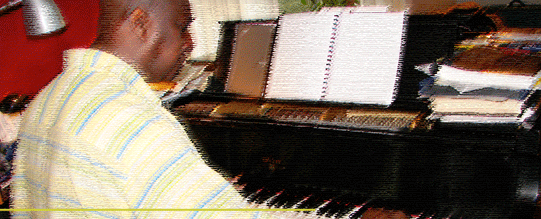
Arthur Goodridge, whose parents are from Barbados, integrates music from his black heritage with European, Latino and Asian influences, creating a ‘World Music’ sound.
In speaking about the genesis of his music, Arthur says:

“When I was very young, studying saxophone, I studied jazz, and played in a dance band. I was influenced by Ellington, Basie, Herman, etc. But I was also studying classical music and was interested in the French composers Ravel, Debussy and Satie. Other influences were Chopin, Spanish guitar, and later some of the turbulent Russian pianist/composers like Rachmaninoff and Prokofiev. I liked their fearlessness.

In my early teens, dealing with the reality of racism, I started studying martial arts as a way to defend myself as well as a way to channel some of my anger. The study of the Asian fighting arts led me to both the study of Asian philosophy and the music of the East. In both the music and martial arts, I was captivated by the power of the mind, the power of movement and power of sound and, on the other hand, by the vulnerability of the mind, the softness of internal movement, and the necessity for silence.

The Cello and Piano Sonatas are more a Suite rather than four separate sonatas, and should be seen or heard as a ‘World Sonata Suite.’ ‘Chant for Peace’ was written as a lament, a cry for peace and an end to violence. As we see too clearly, violence is everywhere, violence against children, women; ethnic violence, black on black violence, gang violence, drug abuse, alcoholism, suicide, genocide, it goes on and on. In the ‘American Sonata’ I tried to capture the spirit of the Americas, not just the United
States, but the proud determined attitude that I think is reflected in both North and South America. The ‘Spanish Sonata’ is musically the most complex. There are many tempo changes and there is a ‘feel’ and a ‘dance’ in the Spanish music that is both intriguing and allusive. Because of the ‘feel’ and ‘dance’ quality of this sonata, it poses the greatest challenge to the performers, but give the listener so much emotion. The ‘Asian Sonata’ right from the start is tonally Asian, but the first movement is a fugue, a la J.S. Bach but played with the intensity of a Rachmaninoff or Prokofiev. While the second movement is filled with soft Asian melodies and harmonies, the last movement has a more modern sound. There are many times when you think the piece is over, and it begins again, not quite finished, not quite resolved, reflecting some ambivalence of being in the east or west. So taking on the challenge of world peace, embracing and praising the many cultures of our planet, and singing their melodies, we have the ‘World Sonata Suite’ we ‘move together’.

Solitude was written for my students. I talk about moving together and moving together more than likely brings up an image of moving with others. But before you can truly move with others, you have to do the inner work of moving within and integrating and harmonizing the internal aspects of yourself. This is the internal moving together. So I created a piece of meditative music that is over an hour long that assist the listener in going deeper into her or his soul. Solitude will slow you down, will take you to that deep pensive quiet place. Like a powerful mantra it will effortlessly take you deeper into a meditative state and will open you energetically and spiritually. You will be surprised at how your tai chi form has slowed down, your breathing has slowed down and your thoughts have slowed, while listening to solitude. Solitude will enhance your meditation, and if doing the tai chi form, will assist you in experiencing meditation in motion.

Remembering Miles Davis: A Trumpet Concerto, was created over 15 years ago on my keyboard hooked up to my computer. It was an anniversary of the death of Miles Davis. I was thinking of Miles, his amazing contribution to the music world and the greatness and the tragedy of his life. Although Miles was a world renowned trumpet player he had a lot of anger. Miles was angry about the amount of racism he had to endure and often this anger was acted out on the women who were close to him and who cared for him. Over time this anger was turned inward and he became more of a recluse. I was thinking of Miles recording of ‘Sketches of Spain” and what a remarkable piece of music that was and is. And so I started playing into my keyboard. I laid down one track and then another. I was in ‘the zone’. I played for about ten hours with only a few brief interruptions. When I finished, I was completely spent and went to bed. It wasn’t until the next day when I listened to it that I realized that it could be a significant piece.

‘Remembering Miles’ is the most complex piece I’ve written. If you remember what I said about the Spanish Sonata and its complex rhythms and tempo changes, the ‘feel’ and ‘dance’ --- well that complexity is in the concerto. Now add the story of Miles and his struggle with his sexism and racism. Add the ability of a man to go through the trials, struggles, and defeats of life, and yet continue to move forward and create such great music, and share his gift with the world, a world that often tried to shatter him. The strength, determination, wisdom and compassion that is required to do all of the above, I have tried to capture in this piece. ‘Remembering Miles’ captures much of the human condition, its weaknesses and its strength, its defeats and victories, its sadness and its joy. When we stop and listen to the music, then we stop and listen to each other, maybe we can stop some of the hatred and violence. We can move together. When all is said and done, ‘Remembering Miles’ is a celebration of life and a poem praising the human spirit; it is a ‘Triumphant Concerto.’

The Bagatelles: Moving Together With Luciano… One way or another, I have been making music most of my life, but it wasn’t until adulthood that I began studying piano, and mostly to use a tool for my composing. So as I progressed, my teacher handed me J.S. Bach’s ‘Two Part Piano Inventions’. I had heard them played before and was fascinated by them. However, they are not the easiest pieces to play. They do teach you how to play in all the major and minor keys, but require some serious practice. As a musician I understood the importance of being able to play in all the keys, but I knew from a practical point I didn’t have the time to put that practice in that would do these pieces justice. So I decided to write shorter and simpler pieces, each being in a different key. I wrote only twelve pieces and then transposed each to its minor key. I did this because I thought it would be more interesting and easier to hear and compare the differences between the major and minor keys, the different sound, feel and thus interpretations between the major and minor. Thus the Bagatelles.

With Luciano: It was in the late 70’s and I was running my martial arts studio, Moving Together. I had decided to get back into music. I needed to not be the ‘teacher’ all the time and experience being a student again. I wasn’t interested in playing woodwinds anymore and since I always played around with the piano, I decided to find a piano teacher. I saw Luciano’s ad in a newspaper and gave him a call. When I first met Luciano I knew that there was a connection. After a few lessons it was clear to me that we both taught using similar principles. Although I taught movement and fighting and he taught music, we both emphasized developing a kinesthetic awareness and relationship with our instrument. In his case it was with the piano, in my case it was with your body. So we would talk theory of expression and compare our approaches. Eventually Luciano took some classes with me and we would laugh about how we used the same language to teach what seemed to be two different things.

Luciano taught technique and theory but what was priceless about his teaching was he taught freedom through improvisation. Not improvising using theory but freeing yourself from technique and theory to create, to compose in the now. There are many improvisers who do the correct chord changes with impressive technique but few actually compose in the moment. If you listen to Luciano, each aspect of his improvisations could be pieces that could stand-alone.

When I teach movement I tell my students not to get trapped by habitual ways of moving or responding. If you are pushing or sparring with some one and they get hit or thrown down, if you are present in the moment, you should be as surprised by what happens as they are. Freedom of expression is full of surprises for both the practitioner and artist as it is for the audience.

Since Luciano moved closer to New York to further his career, our sharing was short lived, but we kept in contact. Years passed and I had been doing some composing and decided to visit Luciano in New Jersey. With the Bagatelles in hand, I asked him to look at them. He sat at the piano and started to play through them and started to add to them. I was excited to hear what he was doing with them. So here we are. Meeting again. A meeting of the minds and a meeting of the hearts. Thus ‘out of the bagatettles’.

Moving Together Music Friends:

Luciano Salvatore was born on December 6, 1952 in Hamden, Connecticut and began piano lessons at the age of nine. By age ten, young Luciano was already composing music and performing at recitals and local functions. After high school, Luciano continued his studies at the Berklee College of Music, in Boston, Massachussetts under Edward C. Bedner (piano), Gary Burton (improvisation), and Charles Banacos (piano). Receiving his Bachelor of Music in 1975. Subsequently, Mr. Salvatore accepted a faculty position at Berklee while continuing his education at Boston University with Edith Stern.

Shortly after being certified as a Master of Music, Luciano moved to New Jersey and founded the North Jersey Music Labs, a private firm specializing in piano, theory, composition, improvisation, and voice. Luciano's teaching method has been so successful that he and his students have recently performed at Carnegie Hall. Luciano continues to teach and perform throughout the United States, Japan, Italy and Canada. During this time Luciano has also established himself as a producer of award winning music whose credits include one of the ten best records of 1996, according to JazzTimes magazine.

Peter Zay, soloist on the ‘Sonatas’ and ‘Solitude’, began studying cello with his mother at the age of seven. He went on to study with David Wells as a full scholarship recipient at the Hartt School of Music where he earned his Bachelor of Music. He received his Master of Music degree at the Manhattan School of Music as a student of David Geber. His teachers and coaches have included members of the American, Emerson and Muir Sting Quartets, and the Beaux Arts Trio.

Mr. Zay's musical achievements have taken him to concert halls throughout the United States, Europe and Central America. He is a member of the Hartford Symphony Orchestra and the Hartford Symphony Chamber Orchestra. Peter performs regularly with the Boston Lyric Opera, the Pro Arte Chamber Orchestra, the Boston Modern Orchestra and the American Sinfonietta.

Recently Peter has performed with the Jaspus Piano Trio for concerts in the U.S. and in Spain. He is a regular member of the International Musical Arts Institute summer chamber music concerts in Fryeburg, Maine. While serving as a faculty member he has performed at the Wintergreen Summer Music Festival in Virginia and the Western Washington University Chamber Music Institute. Other festivals to his credit include the Yellow Barn Chamber Music Festival and the Taos Chamber Music festival. Mr. Zay also performs frequently in recital with pianist Anne Chamberlain.

Ranko Konishi-Houston, pianist on the ‘Sonatas’ was born in Osaka, Japan, began studying piano at the age of three. Ranko realized at an early age that music was to be an important part of her life. When she was 17, she moved to Philadelphia to study with Dorothea Persichetti, wife of famed composer Vincent Persichetti. Ranko then went to Indiana University to study with Michael Block. She received both her bachelor and masters degree in Piano Performance from the New England Conservatory of Music where she studied with Randall Hodgkinson, Gabriel Chodos and Victor Rosenbaum. She also studied Piano Pedagogy with Jean Stackhouse.

Ranko teaches privately at her house in Cambridge where she has developed a sensitive, thorough approach to teaching that encourages the beginning student and challenges the more intermediate or advanced player. In addition to teaching, Ranko and her husband Eric are busy raising their 12 year old daughter Jessica, who is also a pianist, violinist, and nationally ranked figure skater. Though busy, Ranko loves teaching and is always open to accepting new students.

Brian Wallace, trumpet soloist on ‘Remembering Miles’, graduated Cum Laude from the Berklee College of Music with a degree in Music Education and has traveled extensively performing throughout the US and Canada. In 1998, Brian performed in Los Angeles with Portuguese singing sensation, Jorge Sylva. Brian also spent 4 years touring with original funk group, ‘Rippopotamus’, their hit song Performa was featured as the theme song to MTV,s 1996 season of ‘Singled Out’. “Rippopotamus’ opened up for numerous national acts including, ‘The Mighty Mighty Bosstones’, ‘Phish’, ‘Queen Latifah”, ‘De La Soul’ and ‘Bare Naked Ladies’. Curerently Brian performs with eight-piece New Haven based jazz ensemble, ‘Fountain Street’.

Sandi Peaslee, conductor on ‘Remembering Miles’, is a published composer, choral director and keyboard artist. For twenty-nine years she taught high school choral music in Lexington, Massachusetts. Following retirement, she directed The Halalisa Singers, a Lexington based ensemble performing world music. Sandi is an active choral festival adjudicator and conductor in the New England area. She also performs professionally as a harpsichordist/pianist.


Sonatas for Cello
and Piano

Solitude:
Solo Cello

Trumpet Concerto:
Remembering
Miles Davis

The Bagatelles

Music Friends of
Moving together


Available Music CDs composed by Arthur Goodridge:

Four Cello and Piano Sonatas Listen

Solo Cello Meditation Listen

Bagatelles for Solo Piano Listen

Remembering Miles Davis: A Trumpet Concerto Listen